Go to the University of Minnesota Twin Cities home page
  • One Stop
  • MyU

GEMS Informatics

Menu
  • Services
    • All Services
    • GEMS Platform
    • GEMS Exchange
    • GEMS Sensing
    • GEMS Learning
    • GEMS Solutions
  • About
    • Who we are
    • GEMS Team
    • GEMS Partners
    • Trust Indicators
  • Activities
    • Insights
    • FAQS
  • Labs
    • Labs Overview
    • Chai Lab
    • Greyling Lab
    • Joglekar Lab
    • Runck Lab
    • Senay Lab
    • Silverstein Lab
  • Contact Us
Internet of thing in Ag
Case Study

Internet of Things (IOT) in Agriculture
Case Study
Back to GEMS Insights
Tech and development training

Learning about technology and product development by doing

Getting technologies to “fit” a specific problem requires inventors understand both the problem context and the specifics of new potential technologies. GEMS Learning developed a full day workshop focused on hands-on learning with internet of things technologies to address problems in agriculture.

Light Grey

Inspiring students with the potential of technology in agriculture

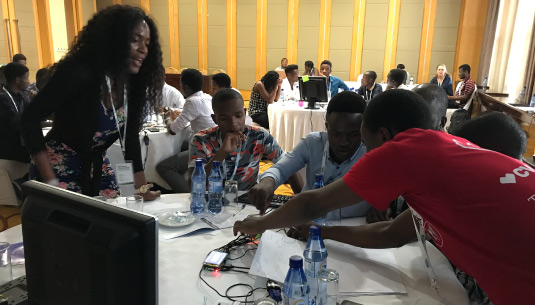
Information communication technologies have the potential to address complex problems in agriculture globally, but getting the technologies to fit the specific context often hinders broader adoption. The Internet of Things (IoT) Bootcamp was designed to engage groups of students in hands-on learning with both identifying challenging problems in agriculture, understanding how internet of things technologies collect and send data, and evaluating whether or not such technologies can actually generate their intended impact.

Bootcamp Curriculum

Workshops were delivered at Stellenbosch University in South Africa and in Lilongwe, Malawi to nearly fifty learners. The workshop started with activities on problem identification. Students identified problems ranging from irrigation management to post-harvest food storage and processing. Then, the workshop takes students in small groups through each step of the data flow from the point of sensor data collection through to storage in a database in the cloud. After developing potential application areas and learning how IoT technologies work, students developed proposals for how they could advance specific product ideas with IoT to address the problems.


Light Grey

GEMS Services Used in the Ag. Internet of Things Bootcamp

Learning

GEMS Learning 

GEMS Sensing

GEMS Sensing 

SA and Malawi bootcamp training

Summary

GEMS offered bootcamps on IoT in South Africa and Malawi to roughly fifty learners. Learners identified potential challenges in their local agricultural context, learned how IoT technologies work, and then evaluated the potential fit for IoT technologies to a specific agricultural problem. In the end, learners came away with enhanced skills in both technology and product development in agriculture.

GEMS Service in action
Find out about GEMS services
About GEMS
More about the GEMS initiative
Our Case Studies
Read about GEMS results
GEMS Labs
GEMS Research
GEMS Informatics Logo M

GEMS Informatics is jointly led by the College of Food, Agricultural and Natural Resource Sciences (CFANS) and Research Computing (including both the Minnesota Supercomputing Institute and U-Spatial) at the University of Minnesota.

248 Ruttan Hall,
St. Paul,
MN 55108

Contact number:
612-624-7253

Connect With Us

  • Home
  • Products & Services
  • About GEMS
  • GEMS Team
  • Case Studies
  • Support
  • FAQs
Favicon 80 GEMS

GEMS®, GEMSOpen®, GEMShare® and GEMSTools® are registered trademarks of the Regents of the University of Minnesota.

  • GEMS Informatics
  • Terms of Service
  • |
  • Privacy Policy

For Students, Faculty, and Staff

  • One Stop
  • MyU
  • Services
    • All Services
    • GEMS Platform
    • GEMS Exchange
    • GEMS Sensing
    • GEMS Learning
    • GEMS Solutions
  • About
    • Who we are
    • GEMS Team
    • GEMS Partners
    • Trust Indicators
  • Activities
    • Insights
    • FAQS
  • Labs
    • Labs Overview
    • Chai Lab
    • Greyling Lab
    • Joglekar Lab
    • Runck Lab
    • Senay Lab
    • Silverstein Lab
  • Contact Us