
Growing Agri-Food Value Chains
Agri-food value chain intelligence for Malawi
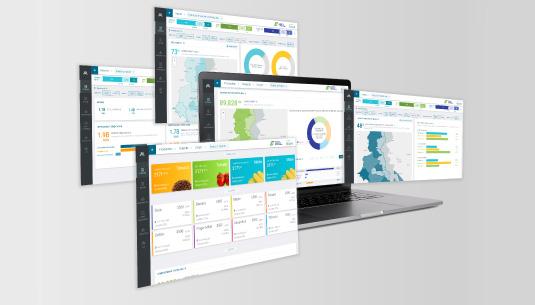
The Market Segmentation Tool (MST) we developed is an online dashboard that supports creating new and strengthening existing market linkages throughout agri-food value chains in Malawi. It provides spatially and temporally aware, client-tailored, business intelligence data to farm input suppliers, off-takers, processors, and exporters by way of a user-friendly interface.
Impact and communities
In partnership with the Centre for Agricultural Transformation (CAT) and funding from the Foundation for a Smoke-Free World (FSFW), we developed a queryable dashboard to give market participants in the agri-food sector dynamic access to the data they need, when they need it. The tool helps identify and inform efforts to address unmet market opportunities in Malawi, reaching more agricultural producers (small-, medium-, and large-scale) with better and more profitable products and services than are available today.
Process and problem solved
Many small-scale producers in Malawi experience low productivity, income and profit, in part because they do not have affordable and timely access to the right inputs, financial products and market linkages that meet their needs. MST helps match specific farmer cohorts to the (public and private) agri-food agencies that serve them and guides geographically explicit choices about where in the country to best make investments and develop value chain infrastructure.
GEMS Services Used to support Growing Agri-food Value chains

GEMS Platform
(annual subscription)
Efficiently moving inputs and outputs to and from farms
Location matters much for agricultural producers and processors alike. A potential crop processor may be seeking districts with large concentrations of (small-scale) farmers that market most of their soybean production and have highly diversified sources of income. These farmers may be early adopters of a new soybean variety, whereas those in other areas may require additional help (e.g., extension support or subsidized credit services), or require targeted infrastructure investment.
Not all small-scale producers are the same. Market development efforts that take more nuanced approaches to targeting their efforts are likely to be more cost-effective and impactful. Small-scale farmers vary in a myriad of ways that have important market development implications. These include their economic (e.g., total sales) versus farm area size, their degree of market participation (e.g., subsistence, transition, pre-commercial and commercial operations), current or potential product focus, and poverty or gender head-of-household status. Importantly, producers also face varying agroecological (including climate) realities, as well as physical and economic distance to markets of different sizes and status (e.g., local, regional or national processing facilities, population sizes, transit ports for perishables, input dealerships, and so on).
Getting ready access to this nuanced information is why we created the MST.

GEMS Solutions
(consulting hours)
How it Works
The MST is an interactive market segmentation dashboard accessed via a publicly available URL. Users get nuanced insights into market segments that draw on more than 100 market relevant variables in a spatially explicit way through simple charts, graphs and mapped representations. User generated figures, along with the underlying publicly-available data, can be downloaded for future use.
Using the MST, users can spatially segment farmer cohorts using a combination of four categories: poverty status, assets, market orientation and income diversification. Thus, rather than simply targeting, say, “small-scale” farmers who cultivate less than 5 hectares of land, users can refine their targets to identify those areas where producers cultivate less than 1 hectare and spend 70% of their total value of production on inputs.
Once the market cohorts are defined, the user then navigates through the dashboard to explore the production, market orientation and income diversification practices of these targeted market cohorts. This insight is further enhanced with market access and agro-ecological information such as time to market, population density, road density, climate variables and soil types.
The MST currently uses publicly available data to inform value chain creation in Malawian agriculture. The tool has been specifically built to be readily deployed in other countries, and has secure data privacy protocols that can ingest sensitive commercial data (if desired, blended with the public data) for private-facing applications used by commercial clients. Contact us if interested.
This was produced as part of the Center for Agricultural Transformation, an effort led by Land O’Lakes Venture37 and funded by the Foundation for a Smoke-Free World, Inc. Produced with the help of a grant from the Foundation for a Smoke-Free World, Inc. The contents, selection and presentation of facts, as well as any opinions expressed herein are the sole responsibility of the authors and under no circumstances shall be regarded as reflecting the positions of the Foundation for a Smoke-Free World, Inc.