Go to the University of Minnesota Twin Cities home page
  • One Stop
  • MyU

GEMS Informatics

Menu
  • Services
    • All Services
    • GEMS Platform
    • GEMS Exchange
    • GEMS Sensing
    • GEMS Learning
    • GEMS Solutions
  • About
    • Who we are
    • GEMS Team
    • GEMS Partners
    • Trust Indicators
  • Activities
    • Insights
    • FAQS
  • Labs
    • Labs Overview
    • Chai Lab
    • Greyling Lab
    • Joglekar Lab
    • Runck Lab
    • Senay Lab
    • Silverstein Lab
  • Contact Us
Growlers hero
Case Study

Genomes to Growlers | Case Study | GEMS Informatics

Case Study
Back to GEMS Insights
Malting Barley Map graphic

The Changing Demand for Malting Barley

Hand in hand with the dramatic rise in micro-breweries across the US, there has been a change in consumer demand of the barley used to produce the beer they drink. The emphasis is on locally-sourced ingredients and environmentally friendly growing conditions.

Light Grey

Impact and partners

GEMS has collaborated with Kevin Smith (UMN’s barley breeder), Jeff Neyhart (USDA-ARS) and breeders from other states to better target their barley breeding efforts, cognizant of these new, and still evolving, market demand realties. This involves generating information products that support decisions to breed the right varieties for the right agro-ecologies to best serve the changing supply chain.

Process and problem solved

GEMS is building out a suite of modularized, increasingly-more powerful analytical tools that help breeders optimize the choices that make in terms of which genetics to test, in which locations, for which season (winter versus spring), and under what crop management strategies. The overarching objective is to provide an on-going stream of actionable information to inform the optimal development and deployment of new barley varieties given the spatially and temporally variable market and environmental realities faced by farmers.


Light Grey

GEMS Services Used for Genomes to Growlers

Solutions


GEMS Solutions 
(consulting hours)

exchange logo 160

GEMS Exchange 

Phenotypic value graph

Summary

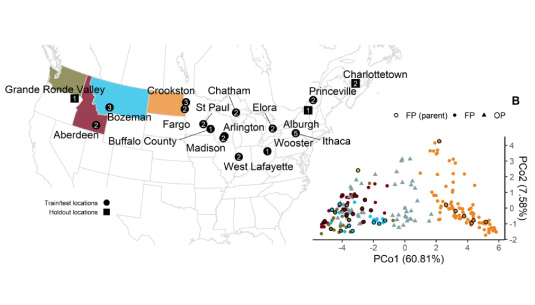
We set out to create models that would allow us to predict where individual varieties of barley would grow optimally when considering not only yield but other phenotypic and quality traits as well. We were very successful with this endeavor, as described in our publication in Crop Science. Trained on only 3 years of field trial data, our predictive model achieved between 0.87 - 0.95 correlation with real measurements for yield, plant height, plant protein, heading date and test weight. This accuracy held not only for the founding parents that were used to train the model in new locations, but also for their offspring as well (omitted entirely from training).

GEMS Service in action
Find out about GEMS services
About GEMS
More about the GEMS initiative
Our Case Studies
Read about GEMS results
GEMS Labs
GEMS Research
GEMS Informatics Logo M

GEMS Informatics is jointly led by the College of Food, Agricultural and Natural Resource Sciences (CFANS) and Research Computing (including both the Minnesota Supercomputing Institute and U-Spatial) at the University of Minnesota.

248 Ruttan Hall,
St. Paul,
MN 55108

Contact number:
612-624-7253

Connect With Us

  • Home
  • Products & Services
  • About GEMS
  • GEMS Team
  • Case Studies
  • Support
  • FAQs
Favicon 80 GEMS

GEMS®, GEMSOpen®, GEMShare® and GEMSTools® are registered trademarks of the Regents of the University of Minnesota.

  • GEMS Informatics
  • Terms of Service
  • |
  • Privacy Policy

For Students, Faculty, and Staff

  • One Stop
  • MyU
  • Services
    • All Services
    • GEMS Platform
    • GEMS Exchange
    • GEMS Sensing
    • GEMS Learning
    • GEMS Solutions
  • About
    • Who we are
    • GEMS Team
    • GEMS Partners
    • Trust Indicators
  • Activities
    • Insights
    • FAQS
  • Labs
    • Labs Overview
    • Chai Lab
    • Greyling Lab
    • Joglekar Lab
    • Runck Lab
    • Senay Lab
    • Silverstein Lab
  • Contact Us